
An advanced technique to dramatically reduce ACL re-injury risk and restore full rotational stability.
The Anterior Cruciate Ligament (ACL) connects the shinbone to the thighbone and is one of the primary stabilizers of the knee. When you tear your ACL, you may also injure structures on the outside of the knee that control rotation. Lateral Extra-Articular Tenodesis (LET) is an additional procedure performed alongside ACL reconstruction to restore this rotational stability.
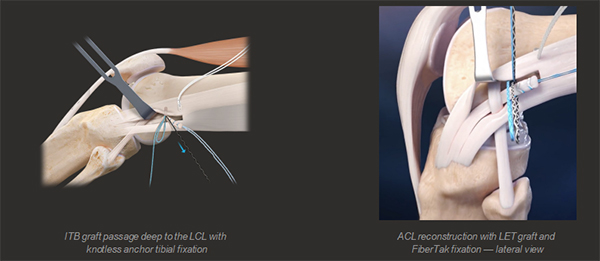
What is Lateral Extra-Articular Tenodesis (LET)?
LET uses a small strip of your iliotibial band — the strong tissue on the outside of your thigh — to reinforce the lateral side of your knee.
Think of it as an additional safety belt working alongside your new ACL graft, protecting it during the cutting, pivoting, and direction changes that athletes demand of their knees.
Why is LET Beneficial for Athletes?
|
Reduced Re-Injury Risk Elite athletes drop from 14% re-injury to just 5% with LET. Patients are 3× less likely to experience graft failure. |
Better Rotational Stability Restores normal knee movement and reduces abnormal pivot shift — critical for soccer, basketball, football, and skiing. |
|
Same Return-to-Sport Rate ~88% return to sport — same as ACL alone — but with significantly fewer re-tears over an athletic career. |
No Added Complications LET does not increase complication rates or meaningfully slow recovery timelines. |
LET for Revision ACL Surgery
If a previous ACL reconstruction has failed, adding LET is particularly important. International experts now recommend LET for most revision ACL reconstructions.
|
82% lower re-failure risk |
Studies show an 82% lower risk of re-failure compared to revision ACL surgery alone — dropping the failure rate from 18% to just 3%. This is a game-changer for patients who have already experienced a failed graft. |
What to Expect
- Surgery
LET adds approximately 15–20 minutes to ACL reconstruction. Dr. Stark uses a small strip of your iliotibial band — no separate procedure or additional incision is required. - Recovery
Rehabilitation follows the same general program as standard ACL reconstruction. Some patients experience slightly more stiffness in the first few weeks, but this resolves by 6 months post-surgery. - Long-Term Outcomes
Patients with LET achieve equal or better functional scores, with the key advantage of significantly fewer graft failures over their athletic career.
Who Should Consider LET?
- Age 25 years or younger
- High-level pivoting or contact sports
- Significant rotational instability
- Hypermobility / knee hyperextension
- Revision (repeat) ACL surgery
- Steep posterior tibial slope
- Prior ACL tear on opposite knee
Key Statistics
- 3× lower risk of graft failure vs. ACL alone
- 88% return-to-sport rate
- 5% re-injury rate (elite athletes w/ LET)
- 82% lower re-failure risk in revision surgery