
A minimally invasive treatment for large, irreparable rotator cuff tears that cannot be stitched back together.
What Is This Procedure?
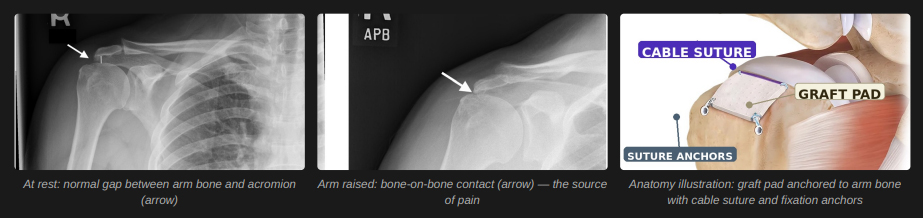
When a rotator cuff tear is too large to repair with stitches, the tendons can no longer hold your arm bone in place. As you raise your arm, the ball of the shoulder presses directly against the bone above it — causing pain with every movement.
This procedure addresses that with two steps, done together through small keyhole incisions:
- Biologic Tuberoplasty (ABT): A thin 3mm pad of donor tissue is anchored over the top of your arm bone. It cushions the joint, stops bone-on-bone contact, and over several months is replaced by your own permanent fibrous tissue. This is not a dissolving implant — it becomes a lasting part of your shoulder.
- Rotator Cable Reconstruction: The rotator cable — a thick band of tissue along the back edge of the cuff that acts like a suspension bridge, distributing forces across the shoulder — is repaired at the same time. This reduces stress on the graft and improves long-term stability.
Results From Published Research
50 patients across 7 centers — including Dr. Stark — followed for up to 9 years. Published in Arthroscopy, 2026.
|
100% of patients had a meaningful improvement |
80% average reduction in pain |
96% felt significant functional improvement |
92% reached a pain level they found acceptable |
0 infections or rejection reactions |
Is This Right for You?
You may be a good candidate if you have:
- A large rotator cuff tear that can't be stitched back together
- Shoulder pain that hasn't improved with physical therapy or injections
- The ability to raise your arm above shoulder height
- No severe arthritis in the shoulder joint
- An intact or repairable front rotator cuff tendon (subscapularis)
Dr. Stark will review your MRI and X-rays to determine if this is the right option for you. Whether or not cable reconstruction is added depends on what is found at the time of surgery.
Why This Over Other Options?
|
Permanent, Not Temporary Unlike balloon spacers (which dissolve in 12–15 months), the graft becomes your own living tissue. Results at 2+ years were equal to 1-year results. |
Less Invasive Recovery No aggressive bone removal. Faster return to motion than superior capsule reconstruction or reverse shoulder replacement. |
|
Addresses Both Problems The graft stops the pain. The cable repair restores load distribution — tackling both the cushioning deficit and mechanical instability together. |
Proven Across 7 Centers Consistent results from 8 surgeons at multiple institutions. Equal outcomes in men and women, and across different levels of tear severity. |